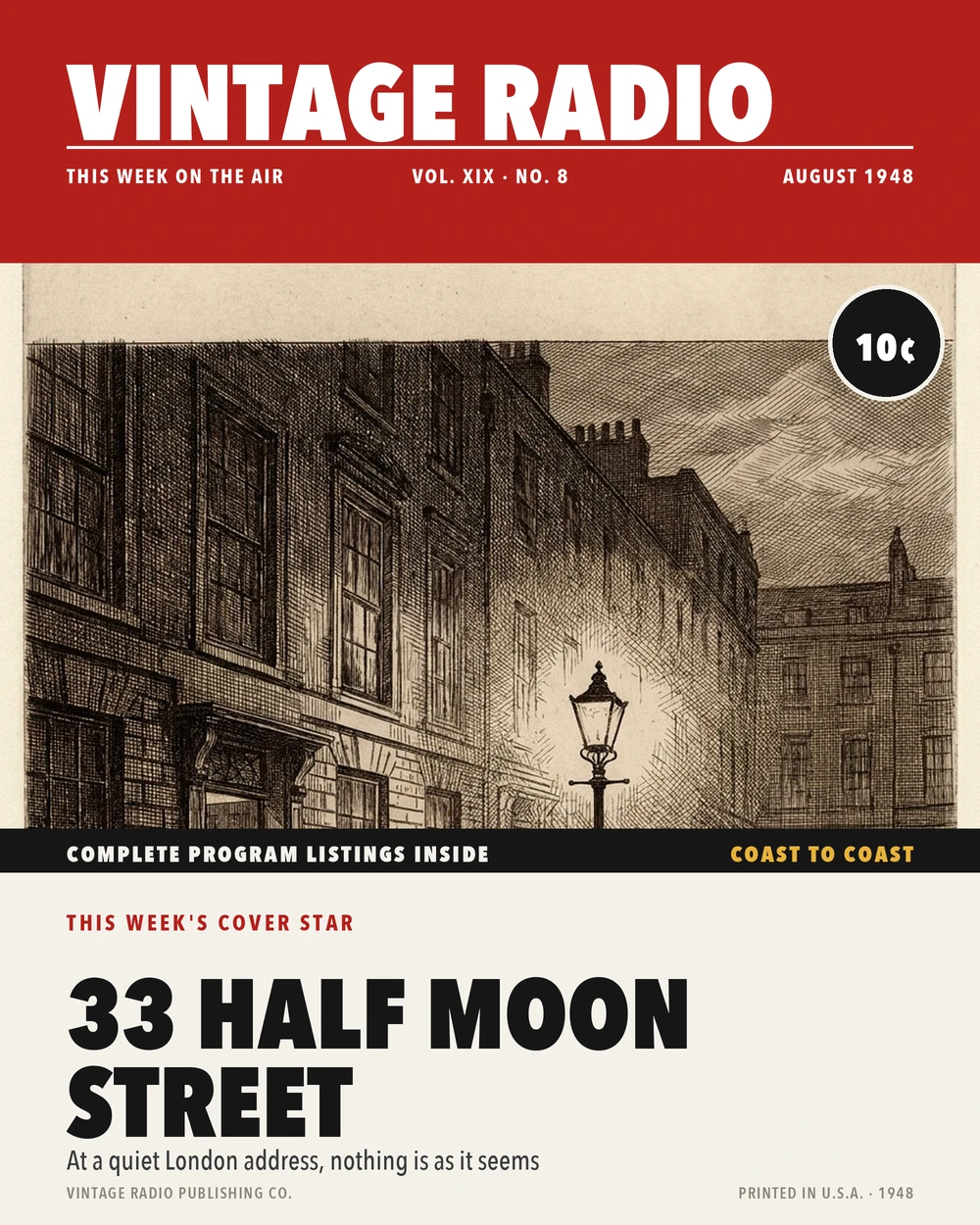
33 Half Moon Street
A Private Eye Firm Unlike Any Other
At the address of the title, a private investigation firm called Assignments Unlimited hung out its shingle with one of the more confident slogans in radio detective history: "We do Anything, Anywhere at Anytime." That was the promise Aubrey Mason made to every client who walked through the door, and episode after episode, the show did its best to make good on it. What sets 33 Half Moon Street apart from most Crime-Detective radio isn't a brooding hero or a rain-soaked urban atmosphere — it's the variety and ingenuity of the cases themselves, which carried the show rather than any particular hard-boiled attitude from its central character.
Aubrey Mason, played by Michael Todd, runs Assignments Unlimited with the help of field operative David Cannon and secretary Penny Fairweather. Mason is the thinker and organizer; Cannon goes out into the world and does the legwork. The arrangement gave the writers a useful structural flexibility — Mason could reason through a problem at the office while Cannon moved through the physical world of the story, and the two perspectives could meet and complicate each other in ways that kept plots moving. Penny Fairweather rounds out the core trio, the kind of capable support character that kept these firms plausible and grounded.
Springbok Radio and Its World
33 Half Moon Street was a product of Springbok Radio, the South African commercial station that operated from 1950 to 1985 under the South African Broadcasting Corporation. Springbok built a genuine radio drama tradition during its decades on air, and 33 Half Moon Street was one of its more accomplished drama series — praised in its time for audio quality and production values that held up against the best the format could produce.
The show has often been compared to another Springbok Radio production, Address Unknown, where an investigator named Henry Simon filled a similar professional role. The two shows shared a format logic: a competent, methodical central figure, an office with a name and a purpose, and a parade of unusual cases to work through. That format proved durable on Springbok, and 33 Half Moon Street pushed it as far as it could go. The jazzy, modern theme music gave the show a feel that listeners compared to American Sam Spade-style detective programs, even though the tone of the stories themselves never went hard-boiled. The cases, not the atmosphere, were the draw.
Supporting cast members Gabriel Bayman and Gordon Mulholland were both established Springbok Radio performers, and their presence underlines how thoroughly the show was embedded in Springbok's professional repertory. This wasn't a cobbled-together production — it drew on people who knew the medium and its demands.
The Writers Behind It
The first seventeen episodes were written by Adrian Steed, who later became a recognized presence on South African television as a presenter and newsreader. Steed was already a multi-faceted Springbok Radio figure before that television career took hold — he wrote and acted in other Springbok productions including No Place to Hide and Squad Cars — and the early episodes carry the confidence of someone who understood both dramatic construction and the particular demands of radio storytelling.
The remaining episodes were written by Douglas Laws, another prominent Springbok Radio personality known as both a writer and a performer on the station. The handoff between two writers with deep roots in Springbok's creative community apparently caused no serious disruption in the show's character or quality, which speaks to how well-defined the series format was by the time Laws took it over. Each episode runs approximately twenty-five minutes — tight enough to demand economy, long enough to develop a genuine plot.
When It Ran
The dating of 33 Half Moon Street is a small puzzle worth being honest about. The surviving episodes point overwhelmingly to a main run in 1965 and 1966, and most sources treat those two years as the heart of the series. But the episode record also carries a premiere date of May 6, 1956 — a decade earlier — which raises the possibility that the show began in some form well before the commonly cited start. Whether that earlier date reflects a true series premiere, a pilot, or a different phase of production isn't settled. The latest known broadcast is April 12, 1966, and the main body of surviving material comes from that final 1965–66 period.
What's clear is that the show arrived late relative to the American and British radio drama booms it resembles. By the mid-1960s, radio drama was in decline in most English-speaking markets. Springbok Radio was something of an exception — it kept producing drama well past that point — and 33 Half Moon Street belongs to a tradition of a station that kept the lights on longer than the conventional timeline suggests was possible.
The Episodes and What Survives
Forty-five episodes are known to survive. The claim of fifty-eight total episodes produced has circulated in earlier descriptions of the show, but that figure hasn't been independently confirmed, and the consistent count in available documentation is forty-five. Whether the gap represents lost recordings, unbroadcast scripts, or an overcounting in earlier catalogs isn't known.
The episode titles give a good flavor of the show's range: "The Curse of the Silver Charlie," "Overture for an Overcoat," "A Widow in Black," "The Temporary Husband," "Killer Killed Twice," "No Money for Honey," "Green for Danger." There's wit in those titles — the show clearly didn't take itself too grimly — and they signal a series happy to move between registers, from the genuinely sinister to the lightly comic. "Three for the Omnibus," "Confidential Cargo," "The Moon and a Million," "Brass for the Broker" — the variety is real, and it reflects the anything-anywhere-anytime premise that Assignments Unlimited advertised.
The preservation of what survives owes something to organized effort. The Springbok Radio Preservation Society of South Africa, formed in 2002, worked to archive material from the station's run, and in 2012 formally transferred its archives to the SABC. That kind of institutional attention matters — Springbok Radio's drama output might otherwise have fared worse than it has.
Why It Still Holds Up
33 Half Moon Street worked because it kept its priorities straight. The cases were the product, not the persona of its detective. Mason is competent and assured without being a type — he doesn't drink too much, he doesn't have a tragic past on display, he doesn't trade in cynical one-liners. Assignments Unlimited is simply a firm that takes hard cases and solves them, and the show's pleasure comes from watching that process unfold across twenty-five brisk minutes of well-produced radio.
For a South African production from the tail end of radio drama's viable commercial run, 33 Half Moon Street achieved something genuinely uncommon: a consistent level of craft that made it comparable to the best English-language radio detective work of its era. The writing changed hands partway through, the run may have started earlier than the surviving evidence clearly shows, and the exact episode count remains an open question — but none of that changes what the surviving forty-five episodes demonstrate about what Springbok Radio was capable of when it was working at full stretch.